

DISEASE AND PEST MANAGEMENT IN RICE
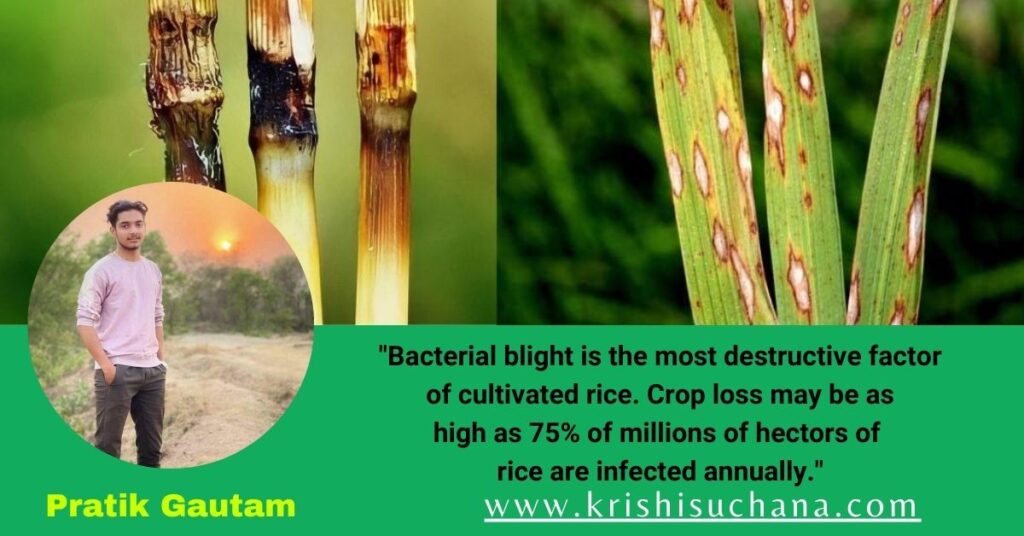
Nepal is the agriculture country lies between India and China. It is divided into three regions; Terai, hilly and mountain. In Nepal, most cultivated crop is rice. Rice is cultivated in all parts of Nepal. About 50% of people are engaged in rice cultivation. The rice cultivated in Nepal is not enough and imported from the other country. As the cultivation of rice is harmed by many disease which causes the yield reduction directly. About 10-15% of our yield is reduced by disease and pest every year which is the main problem of our country.
DISEASE IN RICE
1] Bacterial blight
2] Brown spot
3] Blast
4] Stem rot
5] Sheath blight
BACTERIAL BLIGHT
Bacterial blight is the most destructive factor of cultivated rice. Crop loss may be as high as 75% of millions of hectors of rice are infected annually. It is caused by Xanthomonas oryzae. It causes the wilting of seedling and yellowing of leaves.
CONTROL MEASURES OF BACTERIAL BLIGHT:
- By developing resistant varieties that are able to withstand bacterial infection.
- Maintaining field sanitation through the removal of infected straw that acts as carriers of disease.
- Through harvesting seeds from disease free crops and before sowing, disinfecting seeds.
- Burning the crop residue that are previously contaminated without leaving in the ground.
BROWN SPOT
It is the fungal disease which infects the leaf sheath, panicle branches, glumes and spikelets of rice. It is the most damaging rice disease. Unfilled grains and discolored seed are also formed by this disease. It is the most common in highly humidity areas and nutrient deficient soil. It causes the yield loss of rice.
CONTROL MEASURE OF BROWN SPOT:
-By improving the soil fertility through regular monitoring of soil nutrients and applying fertilizer.
-sowing the seeds of resistant varieties so as to reduce the loss of infection.
-treating the seeds of fungicides such as propiconazole, trifloxystrobin.
BLAST
Another disease which affect the rice is blast caused by fungus Magnaporthe oryzae. It is also the most destructive disease of rice. It affects in leaf, collar, neck, parts of panicle, node and leaf sheath. It can kill seedling up to tillering stage.
CONTROL MEASURE OF BLAST
- By segregating healthy seeds of diseased crops and sowing them as resistant varieties.
- By maintaining clean fields that can be the sources of infection.
- By burning or burning the diseased plants.
- Following recommended space during planting that is 20*20cm to enhance aeration and light penetration.
STEM ROT
Stem rot leads to formation of lesions and production of chalky grown and unfilled panicles. It is found in upper soil layer. It causes the leaf sheath decay and lodging and lower grain filling. It causes heavy loss in our country.
CONTROL MEASURE OF STEM ROT:
- Use the resistant variety
- Reduce plant density as planting
- Control weeds in and around the field
- Increase the content of potash to keep soil and pH high
- Burn any crop residue after harvest and donot let the straw decompose.
SHEATH BLIGHT
It is the major disease in rice which is caused by Rhizoctoria solani. It affects the leaves senesce or dry out and die more rapidly, young, tillers can be also be destroyed. It occurs in high temperature area (28-32 degree C) and humidity up to (85-100%).
CONTROL MEASURE OF SHEATH BLIGHT
- By avoiding the use of infected seeds
- By avoiding the excessive use of nitrogen fertilizer.
- Treating the seeds with fungicide before sowing
- Adopting crop rotation with dicot crops as the fungus reads easily in monocot crops.
Writer: Pratik Gautam (Student, Bsc. Ag IAAS Paklihawa Campus)