
INCREASING PRODUCTIVITY THROUGH ORGANIC FARMING IN RICE
Introduction
Rice is the number one crop in terms of cultivated area, production, consumption and contribution to the economy in Nepal. It is the most staple food for Asian countries and Nepal. The total paddy production of Nepal in 2010 is forecasted to be 5,431,549 Mt, representing 1.7% decrease compared to 2018 (5-6 million MT). The total area of paddy planted decreased slightly compared to the last year, it was estimated to be 1,480,288 hectares against 1,491,744 hectares for 2018.
Rice contributes about 7% to national GDP and 20% to AGDP. It fulfills more than 50% calorie requirement. Its chemical consumption includes carbohydrate (79%), protein (7-8%), oil (2-5%), fiber (0.8%), ash (5.9%). Rice is also rich source of Vitamin B complex. There are there are total 24 species, 22 wild species and 2 cultivated species. Oryza sativa has 3 subspecies: L.ssp.indica, L.ssp.japonica, and L.ssp.javonica.
The production of rice is more on temperature compared to tropical region to tropical region. Temperate range for rice production is 20-35°C. The optimum temperature is about 25°C. Rice can be grown in wide range of pH 4.5-8. Optimum pH 5.5-7.5. The method of sowing rice includes:
- Direct seeded rice (DSR)
- Transplanted rice
Economic growth of our country is directly affected by cereal crop which contributes 1/4th GDP and more than 2/3rd of farm household income is generated from rice production.
POPULAR RICE VARITIES
The popular rice varities grown in the three agro-ecological zones of Nepal are as follows:
In terai,
Spring rice (February/March-June/July), Chaite-2 (JR7151-1260-3-30, Chaite-4 (JR9729-67-3), ch-45, Bindeswari (JRT1444), Mansuri, Savitri, Makawanpur-1, Janaki, Upland rice.
In hills,
Taiching 176, Khumal 4, Pokhareli masina
RESEARCH AND PRODUCTION
A total of 38 rice varities have been released so far of which 10-12 varities have been widely adopted by farmers. These varities have helped increase the yield by over 1ton/ha compared with local varities fit into the cropping patterns and as a result farmers have been able to produce two rice crops a year as well as a third crop. Harvesting main season rice by the end of October allows farmers to plant which crops in time and further higher yields of winter crops are being obtained.
Previously varities were released without a good understanding of the ecosystems or of the farmer’s circumstances and needs. Nowadays, this is no longer true. The rapid rural appraisal survey has provided information on research priority areas. A study on returns to wheat research in Nepal, for example showed a rate of return of 75% from 1960 to 1990 and an annual gain in yield potential of 1.3%. The relationship is yet to be established in rice, but it is believed that more than half a million tons of rice production is attributable to modern varities.
PROBLEMS IN RICE CULTIVATION
Physical constraints
About 79% of the rice area is rainfed, of which about 70% is lowland and 9% is upland. The crop either suffers from prolonged drought or is submerged as a result of excess rainfall for a long period (owing to absence of drainage) under rainfed lowland conditions. This result in poor rice yields, yet farmers is reluctant to grow modern varities of rice under these conditions. The availability of irrigation is imperative for increased rice production, but irrigated. Adverse topography and soils also seems to be significant constraints to high rice yields 2n deficiency has been increasing common and thus adversely affect rice yields. Isolated cases of soil acidity, poor drainage and siltation problems have been reported, but their severity at the national level is yet to be assessed.
Biological constraints
Diseases, insects and weeds are the major biological constraints to high rice yields, in Nepal. More than 19 fungi, 5 nematodes 4 bacteria and 2 viruses are reported to affect rice plants in the country. Blast and bacterial leaf blight are the major production hazards among the diseases. The insects causing the sufficient losses are the gundhi bug (leptoeorisa acuta), hispa (Dicladispa armigera), mealy bug, sogatella tercifera, yellow stemborer, striped borer. Weeds are particularly serious in direct seeded and upland rice. In transplanted condition weeds are a minor problem in the terai.
IMPROVING THE ELEMENTS OF RICE CULTIVATION
The guarantee of food security of any state is to obtain granted yield of high quality agricultural products. The implementations of such a talk are feasible only if all the technological and environmental conditions of its cultivations re met. In the current situations, when along with the growing anthropogenic load on the land of the agricultural fund and the reduction of available irrigation water, as well as non-compliance with agricultural fund and the reduction of available irrigation water, as well as non-compliance with agricultural production technologies. Organic farming is the solution to the urgent problem of obtaining high yield of high quality products without compromising agricultural resource potential of soils. The transfer of production to organic farming should be carried out in stages, due to high cost of its implementations and the use of large number of additional resources (agro-reclamation, economic energy, and labor, technical and technological environment. It was found that the use of phyto sections of various lengths depending on the chemical composition of drainage and discharge water allows one to clean the drainage runoff from mechanical impurities, organic and biogenic elements. This makes it possible to reduce suffecsion and removed of nutrients from rice checks, reduces the irrigation rate by 10%, increases the reclamation state of soils and reduces the cost of rice production by 7%.
BENEFITS IN PRODUCTION OF RICE THROUGH THE METHOD OF ORGANIC FARMING
Organic farming improves the soil quality. One of the organic rice farming in the Philippines had found that organic rice farming utilized only 33% of the cash capital required to grow a hectare of rice when compared with conventional farm which spent 118 VSD/ha. This much reduced cash capital expense in organic rice farming relieved women from the burden of sourcing credit to finance crop establishment. The research shows that organic farming makes the paddy soil loose and had deeper mud which was attributed to the higher soil organic matter (SOM). Loose and deeper mud led to easier and faster land preparation and less weed growths which reduced. The labor required in hand weeding and time to do rotary weeding. Thus, these are socio-economic, energy use and environmental benefits of organic farming.
CONCLUSION
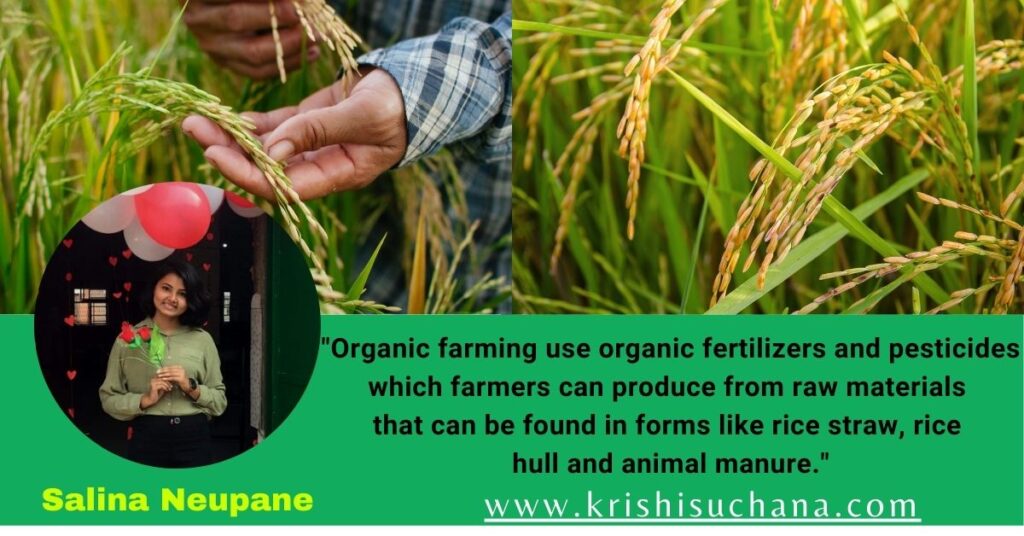
In conclusion, organic farming makes use of organic fertilizers and pesticides which the farmers themselves can produce from raw materials that can be found in their forms such as rice straw, rice hull and animal manure. Hence, farmers and consumers will benefit greatly in going in terms of income, health and environmental protection.
Writer: Salina Neupane (Student, Bsc Ag, IAAS Paklihawa Campus)